## Dawkins
- Arguments for theism are dumb
- Natural selection, the anthropic principle, and luck together explain everything god is supposed to explain.
- Therefore there is almost certainly no god.
### Dawkins Life
- Born 1941
- Grew up Anglican (Christian) but lost his faith in his teens.
- Successful career in biology and ethology
- _Selfish Gene_ popularized ‘gene-centered’ view of evolution (rather than macro traits)
- Turned to modern polemicist against “religion”
- _Blind Watchmaker_ (1986) argues against appearance of intelligent design
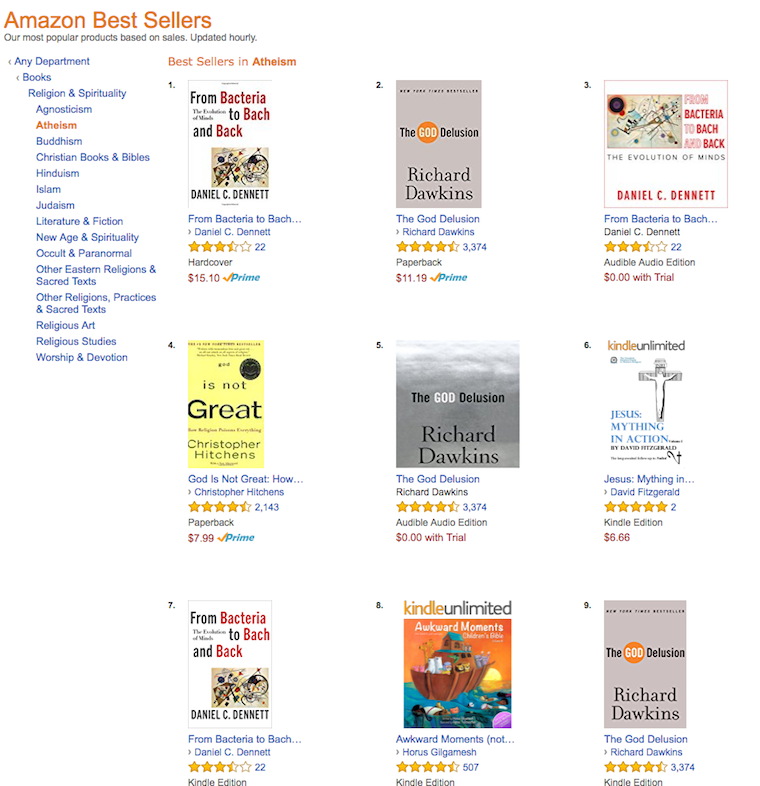
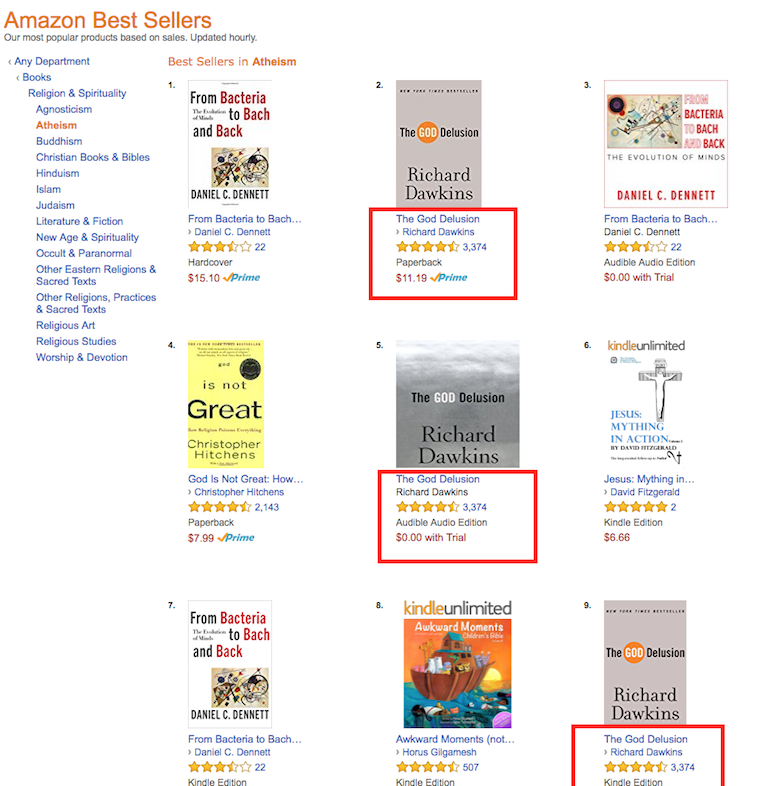
- _God Delusion_ (2008) best seller and #2 book in atheism
### Style
- Dawkins is a polemecist
- Dawkins is a popularizer
- Writes about science but writes _as_ a poet
> There's real poetry in the real world. Science is the poetry of reality

### Christian apologists argue
1. There is almost certainly a God, therefore
2. Religion (and especially Chrisitanity) is the source of great human happiness and many goods for culture, civilization, hospitals, charity, and happiness
3. Atheism is immoral, hyper-intellectual, imbalanced, despairing, and intellectually unfulfilling.
### God Delusion argues
1. There is almost certainly no god, therefore...
2. Monotheistic religion is a cause of evil, suffering, ignorance, stupidity, and war.
3. Atheism on the other hand, can be moral, balanced, happy, and intellectually fulfilled.
### The Core Argument
1. If we can explain 'design' without god, then there is no good reason to suppose a god exists.
2. We can explain 'design' without god (via natural selection, chance, and the anthropic principle).
3. Therefore, there is no good reason to suppose a god exists.
### The Argument, Part I: Against Supernaturalism
1. There is little reason to believe in God except the appearance of design.
2. One of the greatest challenges to the human intellect has been to explain how the complex, improbable appearance of design in the universe arises.
3. The natural temptation is to attribute the appearance of design to actual design itself.
4. The temptation is a false one because the designer hypothesis immediately raises the larger problem of who designed the designer
5. Besides the teleological argument, Aquinas' _other_ arguments for God's existence are stupid.
### The Argument, Part II: For Naturalism
5. The most ingenious and powerful explanation is Darwinian evolution by natural selection.
6. Though we don’t have an equivalent explanation for physics, we should not give up the hope of a better explanation arising in physics, something as powerful as Darwinism is for biology.
8. Therefore, the complex, improbable appearance of design can probably be explained eventually.
9. Therefore, there is no need of God to explain design.
10. Therefore, there is probably no God.
### Against Theism: The First Cause is Simple
> The First Cause argument, work by setting up an infinite regress which God is wheeled out to terminate. But we are never told why God is magically able to terminate regresses while needing no explanation himself. To be sure, we do need some kind of explanation for the origin of all things. Physicists and cosmologists are hard at work on the problem. But whatever the answer - a random quantum fluctuation or a Hawking/Penrose singularity or whatever we end up calling it - it will be simple.
>Complex, statistically improbable things, by definition, don’t just happen; they demand an explanation in their own right. They are impotent to terminate regresses, in a way that simple things are not. The first cause cannot have been an intelligence - let alone an intelligence that answers prayers and enjoys being worshipped. Intelligent, creative, complex, statistically improbable things come late into the universe, as the product of evolution or some other process of gradual escalation from simple beginnings... and therefore cannot be responsible for designing it.
### Response
1. God is simple
2. The first cause is not simple
3. The first cause cannot be contingent
### Teleology
>The only one of the traditional arguments for God that is widely used today is the teleological argument, sometimes called the Argument from Design although - since the name begs the question of its validity - it should better be called the Argument for Design. It is the familiar ‘watchmaker’ argument, which is surely one of the most superficially plausible bad arguments ever discovered - and it is rediscovered by just about everybody until they are taught the logical fallacy and Darwin’s brilliant alternative.
### The Anthropic Principle
>If you set out in a spaceship to find the one planet in the galaxy that has life, the odds against your finding it would be so great that the task would be indistinguishable, in practice, from impossible. But if you are alive (as you manifestly are if you are about to step into a spaceship) you needn’t bother to go looking for that one planet because, by definition, you are already standing on it.
### The Anthropic Principle on Earth
>Suppose life’s origin on a planet took place through a hugely improbable stroke of luck, so improbable that it happens on only one in a billion planets. The National Science Foundation would laugh at any chemist whose proposed research had only a one in a hundred chance of succeeding, let alone one in a billion. Yet, given that there are at least a billion billion planets in the universe, even such absurdly low odds as these will yield life on a billion planets. And - this is where the famous anthropic principle comes in - Earth has to be one of them, because here we are.
### Luck
>The anthropic principle entitles us to postulate a massive dose of luck in accounting for the existence of life on our planet. But there are limits. We are allowed one stroke of luck for the origin of evolution, and perhaps for a couple of other unique events like the origin of the eukaryotic cell and the origin of consciousness. But that’s the end of our entitlement to large-scale luck.
### Luck
>We emphatically cannot invoke major strokes of luck to account for the illusion of design that glows from each of the billion species of living creature that have ever lived on Earth. The evolution of life is a general and continuing process, producing essentially the same result in all species, however different the details.
### Naturalism
>We explain our existence by a combination of the anthropic principle and Darwin’s principle of natural selection. That combination provides a complete and deeply satisfying explanation for everything that we see and know. Not only is the god hypothesis unnecessary. It is spectacularly unparsimonious.
### Naturalism
>Not only do we need no God to explain the universe and life. God stands out in the universe as the most glaring of all superfluous sore thumbs. We cannot, of course, disprove God, just as we can’t disprove Thor, fairies, leprechauns and the Flying Spaghetti Monster. But, like those other fantasies that we can’t disprove, we can say that God is very very improbable.
### 2 Minutes Left
* Questions?
### Harris' Life
- Born 1967 in Los Angeles
- Grew up secular (mom was secular Jew)
- Studied at Standord
- First drugs, then meditation
- BA in Philosophy (Standord), PhD in Neuroscience (UCLA)
- Dissertation was about "how science could determine human values"
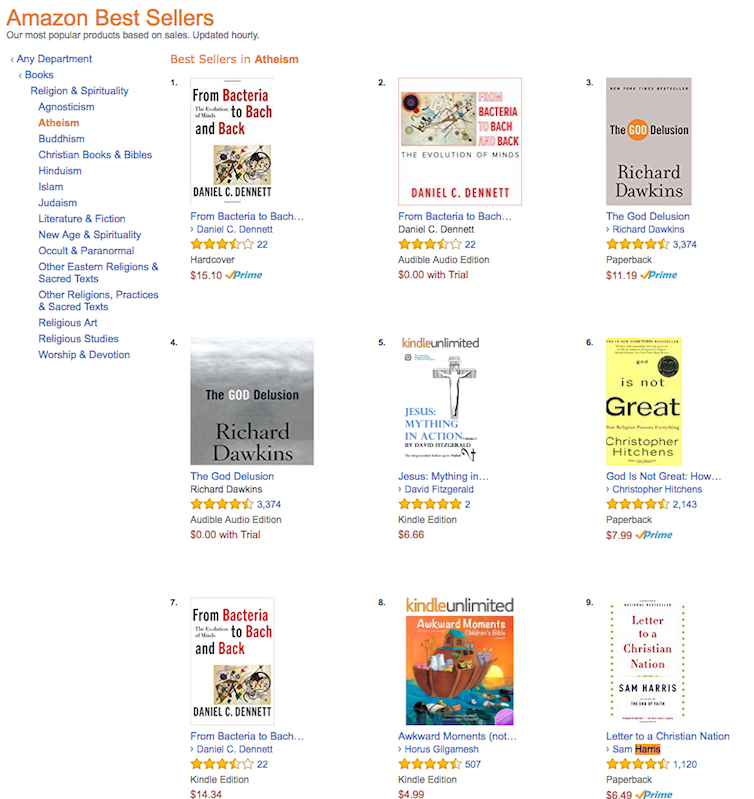
- The _End of Faith_ criticizes Islam and all religion as irrational
### Style
- A CS Lewis of atheism
- Analogies, confidence
- No career to speak of outside of atheism apologist
### Christianity
>Catholic Church has spent "two millennia demonizing human sexuality to a degree unmatched by any other institution, declaring the most basic, healthy, mature, and consensual behaviors taboo."
### Judaism
>the ideology of Judaism remains a lightning rod for intolerance to this day. Jews, insofar as they are religious, believe that they are bearers of a unique covenant with God.
### Islam
>Is it really true that the sins for which I hold Islam accountable are “committed at least to an equal extent by many other groups, especially [my] own”? ... The freedom to poke fun at Mormonism is guaranteed by the fact that Mormons do not dispatch assassins to silence their critics or summon murderous hordes in response to satire. ... Can any reader of this page imagine the staging of a similar play [to The Book of Mormon] about Islam in the United States, or anywhere else, in the year 2013?
### Basic Argument: Evil!
>... people of faith regularly assure one another that God is not responsible for human suffering. But how else can we understand the claim that God is both omniscient and omnipotent? There is no other way, and it is time for sane human beings to own up to this. This is the age-old problem of theodicy, of course, and we should consider it solved. If God exists, either He can do nothing to stop the most egregious calamities, or He does not care to. God, therefore, is either impotent or evil.
### Basic Argument: Evil!
- Children suffer, so God doesn't exist (not valid, but has appeal)
- God is either impotent or evil. If he were powerful and good, he would prevent evil.
### Suffering
- Atheism is "a refusal to deny the obvious."
### Evidence
>The atheist is merely a person who believes that the 260 million Americans (eighty-seven percent of the population) who claim to “never doubt the existence of God” should be obliged to present evidence for his existence—and, indeed, for his benevolence, given the relentless destruction of innocent human beings we witness in the world each day.
>[Since God doesn't exist,] only the atheist is compassionate enough to take the profundity of the world’s suffering at face value. It is terrible that we all die and lose everything we love; it is doubly terrible that so many human beings suffer needlessly while alive. That so much of this suffering can be directly attributed to religion—to religious hatreds, religious wars, religious delusions, and religious diversions of scarce resources—is what makes atheism a moral and intellectual necessity.
### Kreeft
- The problem can be stated very simply: If God is so good, why is his world so bad?
- The problem of evil is the most serious problem in the world. It is also the one serious objection to the existence of God.
>More people have abandoned their faith because of the problem of evil than for any other reason. It is certainly the greatest test of faith, the greatest temptation to unbelief. And it's not just an intellectual objection. We feel it. We live it. That's why the Book of Job is so arresting.
### Solution
1. Evil is not a substance but a wrong choice, or blindness
2. Sin is the cause of all evil and even physical suffering
3. The Son is the solution of the problem of evil; his crucificion and our crucification with Christ
4. Good things happen to bad people too; some suffering his good too; we have to trust God's promises; and hell is the consequence of free will
### 2 Minutes Left
* Questions?