## Utilitarianism
### The philosophy of maximizing pleasure
### Utilitarianism: All the points!

1. Utilitarianism is the thesis that “the best moral action is one that maximizes ‘utility’ — pleasure, well-being.” (definition)
2. Utilitarianism is a theory of normative ethics, a theory of what to do.
3. Utilitarianism was founded by Jeremy Bentham
4. Utilitarianism was updated by John Stuart Mill
5. Utilitarianism has ancient roots in Epicurus
6. Utilitarianism is a form of consequentialism, where right and wrong are determined by the consequences of one’s action or character, not the action or character itself.
7. Utilitarianism has several modern forms
8. Utilitarianism is criticized for being unjust, impractical, or amoral.
1. Utilitarianism is the thesis that “the best moral action is one that maximizes ‘utility’ — pleasure, well-being.” (definition)
2. Utilitarianism is a theory of normative ethics, a theory of what to do.
3. Utilitarianism was founded by Jeremy Bentham
4. Utilitarianism was updated by John Stuart Mill
5. Utilitarianism has ancient roots in Epicurus
6. Utilitarianism is a form of consequentialism, where right and wrong are determined by the consequences of one’s action or character, not the action or character itself.
7. Utilitarianism has several modern forms
8. Utilitarianism is criticized for being unjust, impractical, or amoral.
### 1. The best moral action is one that maximizes "utility"
Philosopher
Summum Bonnum
Aquinas
God
Plato
The form of the Good
Aristotle
Eudaimonia (Happiness)
Mill
Utility (Happiness)
### 1. The best moral action is one that maximizes "utility"
- Utility, or “happiness” is somewhat problematic as it can mean
several different things.
* a short-lived experience or feeling of elation, e.g. the pleasure you derive from eating a good
meal
* a condition of being, typically lasting over a significant stretch of time, e.g. “a happy life”
- Thus, the utilitarian asks us not simply to maximize short-term pleasures but also long-term pleasures.
- That is, it encourages us not to be gluttons and focus on satisfying our basest desires but also to work toward accomplishing things that will make our overall condition more pleasurable, e.g. reaching goals.
### 2. Utilitarianism is a theory of normative ethics, a theory of what to do.
- **Metaethics** asks higher-order questions about what moral terms like ‘good’ mean and why people morally disagree.
- **Applied ethics** tries to resolve difficult ethical questions using normative principles.
- **Normative ethics** tries to figure out true principles. How should I live? How do I resolve moral dilemmas?
- * Example: Profitable fraud versus costly integrity?
- * Example: Follow my family tradition or break out and innovate?
- Utilitarians say: do whatever maximizes happiness.
### 2. Utilitarianism is a theory of normative ethics, a theory of what to do.
- Should marijuana use be made illegal? Does it cause pleasure or pain? Does it maximize pleasure over pain? Consider:
>Pros: Most commonly used illegal drug. (National Institute on Drug Abuse), feel high, have fun.
>Cons: Gateway drug, correlated with mental health problems, anxiety, sleep problems.
- Should rollercoasters be made illegal? Do they cause pleasure or pain? Consider:
>Pros: Rollercoasters are fun. 1 in 300 million chance of dying.
>Cons: Galaxyland Amusement Park (West Edmonton Mall), Edmonton, Alberta, “Mindbender”, June 1986: The world’s largest triple-loop indoor roller coaster crashed when four bolts came loose, allowing a wheel assembly to fall off the roller coaster. Dozens suffered minor injuries, one person had his legs crushed in the accident and three people lost their lives.
### 3. Utilitarianism was founded by Jeremy Bentham

Jeremy Bentham published *An Introduction to the Principles of Morals and Legislation* in 1789.
### 3. Utilitarianism was founded by Jeremy Bentham
> Bentham quote: “Nature has placed mankind under the governance of two sovereign masters, pain and pleasure. It is for them alone to point out what we ought to do… By the principle of utility is meant that principle which approves or disapproves of every action whatsoever according to the tendency it appears to have to augment or diminish the happiness of the party whose interest is in question: or, what is the same thing in other words to promote or to oppose that happiness. I say of every action whatsoever, and therefore not only of every action of a private individual, but of every measure of government.”
The goal was fairness. To create a society with laws and norms that do not harm the majority while only benefitting the minority but benefit all or most.
###4. Utilitarianism was updated by John Stuart Mill.

John Stuart Mill wrote *Utilitarianism* in 1861.
> Mill Quote: “It is quite compatible with the principle of utility to recognise the fact, that some kinds of pleasure are more desirable and more valuable than others. It would be absurd that while, in estimating all other things, quality is considered as well as quantity, the estimation of pleasures should be supposed to depend on quantity alone....
>There is no known Epicurean theory of life which does not assign to the pleasures of the intellect… a much higher value as pleasures than to those of mere sensation.... A being of higher faculties requires more to make him happy, is capable probably of more acute suffering, an certainly accessible to it at more points, than one of an inferior type; but in spite of these liabilities, he can never really wish to sink into what he feels to be a lower grade of existence… It is better to be a human being dissatisfied than a pig satisfied; better to be Socrates dissatisfied than a fool satisfied.”
The goal is to live a life of cultivated pleasure, balancing intellectual and physical satisfaction.
### 5. Utilitarianism has ancient roots in Epicurus.
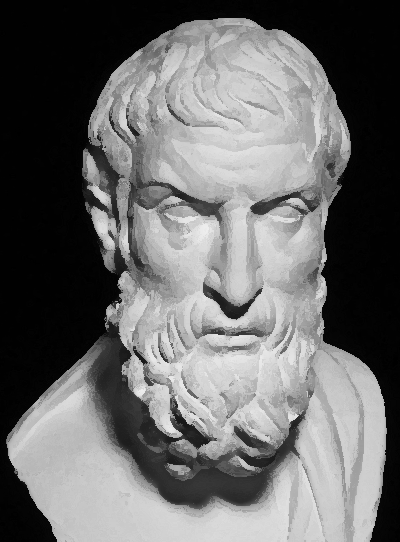
Epicurus (270 BC)
### 5. Utilitarianism has ancient roots in Epicurus.
- He was not an "Epicurean" drunkard, glutton, hedonist.
- He advocated a life of moderation and virtue but he argued this was the most pleasant life.
- The goal was to avoid excesses, extremes, fanaticism, and the suffering they cause.
>"It is impossible to live a pleasant life without living wisely and well and justly, and it is impossible to live wisely and well and justly without living pleasantly."
### 6. Utilitarianism is a form of consequentialism
* **Consequentialist principle:** actions are judged right or wrong not in themselves, but upon the consequences or state of affairs they produce.
### 6. Utilitarianism is a form of consequentialism
What are the alternatives to consequentialism?
- Divine command - some actions are forbidden or commanded by God
- Duty - some actions are permissible or impermissable by the moral law
- Virtue - some character traits are intrinsically good
- (We already discussed divine command theory. We will discuss duty and virtue theories in later weeks.)
- Others: **Happiness principle:** the only relevant consequences are those that influence the happiness of individuals.
- **Principle of Equality:** everyone’s happiness is equally important.
### 7. Utilitarianism has several modern forms
1. Act utilitarianism -- do only those individual acts that maximize happiness
2. Rule utilitarianism -- do only those kinds of acts (rules) that maximize happiness
- Do individual actions have to be judged for their consequences?
RM Hare suggest:
>One ought to abide by the general principles whose general inculcation is for the best; harm is more likely to come, in actual moral situations, from questioning these rules than from sticking to them, unless the situations are very extra-ordinary; the results of sophisticated felicific calculations are not likely, human nature and human ignorance being what they are, to lead to the greatest utility.
Some other forms:
3. Ideal utilitarianism -- do whatever would create an overall ideal world with knowledge, pleasure, friendship, beauty, and so on
4. Preference utilitarianism -- do whatever would allow the most people to decide what is good for themselves and pursue it
### Review

1. Utilitarianism is the thesis that “the best moral action is one that maximizes ‘utility’ — pleasure, well-being.” (definition)
2. Utilitarianism is a theory of normative ethics, a theory of what to do.
3. Utilitarianism was founded by Jeremy Bentham
4. Utilitarianism was updated by John Stuart Mill
5. Utilitarianism has ancient roots in Epicurus
6. Utilitarianism is a form of consequentialism, where right and wrong are determined by the consequences of one’s action or character, not the action or character itself.
7. Utilitarianism has several modern forms
### 2 minutes left
* What are your questions?
* Write a short response to what you've read so far. A question, comment, or thought, to share in class.
* Then, review "objections"
# Objections to Utilitarianism
*The good, the bad, the ugly*
### Objections to utilitarianism include injustice, impractical, amoral
### Objection 1: Utilitarianism Relies on Hedonism and Hedonism is False
* P1: The utilitarian accepts the happiness principle and so reduces all morality to pleasure-seeking.
* P2: However, even if the type of pleasure we seek is not base in nature, there are things we think are valuable that are not pleasure, e.g. honesty, bravery, etc.
* C: Therefore, utilitarianism is false
### Objection 2: Incompatible with fairness
* P1: If utilitarianism is true, then sometimes unjust acts would be morally permissible (e.g., convicting someone for a crime they did not commit to make people happy, such as to punish a scapegoat).
* P2: It would be wrong to convict a person for a crime they did not commit.
* C: Therefore, utilitarianism is not true
### Objection 2: Incompatible with fairness
- P1: If utilitarianism is true, then it is possibly morally permissible to convict the innocent.
- P2: No true ethical theory allows convicting the innocent.
- C: Therefore, utilitarianism is not true.
### Objection 2: Incompatible with fairness
- However, a utilitarian can argue that P1 is false because a careful consideration of the consequences would show that scapegoating decreases happiness.
- That is, in the short-term you may think that scapegoating will help you get away with x, y, or z, but it seems as though you will ultimately get caught and this will have very bad consequences, e.g. no one will trust you, your friends will dislike you, etc.
###Objection 3: Utilitarianism allows for violating rights
- P1: If utilitarianism is true, then sometimes it is acceptable to violate someone’s basic human and legal rights (e.g. right to privacy, life, right to not be unlawfully detained, etc.)
- P2: It is not acceptable to violate someone’s basic human and legal rights.
- C: Therefore, utilitarianism is not true
### Objection 4: Utilitarianism Ignores the Past
* P1: If utilitarianism is true, then we should solely focus on the consequences that will result from an action and ignore any factors that led to that action.
* P2: There are times when factors that lead up to an action matter for how we evaluate the goodness or wrongness of an action, e.g. making/breaking promises, evil actions, etc.
* C: Therefore, utilitarianism is not true
### Objection 5: Utilitarianism is too demanding
- Given the current state of the world and the impoverished state so many people live in, treating everyone’s happiness equally would currently demand that we give away nearly all of our money and do everything we can to help others (of course, we should not give away so much that we decrease happiness). On the basis of this, people reject utilitarianism because (i) they think that this asks too much of us and it (ii) confuses acts that are supererogatory (one’s that go above and beyond our moral requirements) rather than obligatory.
### Objection 5: Utilitarianism is too demanding
- **Response**: Bite the bullet. Yes, utilitarianism goes against our intuitions about justice and rights, but this is because our intuitions are wrong. Yes, utilitarianism is demanding in terms of what it asks us to do, but this is because human beings tend to be bad people and should radically change their lives. Our intuitions about what is right and wrong have been wrong in the past (e.g. slavery) and there are probably other beliefs we have that are also wrong.
### Objection 6: Utilitarianism undermines true friendships
* P1: The equality principle of utilitarianism does not allow us to be preferential toward family members,
loved ones, or friends.
* P2: No one could ever consistently adopt a non-preferential attitude.
* C: Therefore, utilitarianism is an unreasonable theory that should be rejected.
### Some Arguments for Utilitarianism
### Abduction
If we consider the various moral principles we hold (e.g. don’t lie to friends), we can ask ourselves the following question: why do we accept these principles? One answer to this question is that because holding to such a principle, on the whole, makes people happy more often than not. And so, the utilitarian can argue as follows:
P1: We would only accept an ethical theory that can explain the universal moral law ("common morality").
P2: Utilitarianism best explains the universal moral law.
C: Therefore, we should accept utilitarianism.
### Your view?
- Suppose there is a murder or terrorist attack with an unknown perpetrator.
- We can make many people happy by scapegoating an innocent homeless man. You could arrest him, try him in a court of law, and convict him to death.
- Very few people would miss him.
- You and he know he was innocent so his suffering would be great; but the pleasure would be great for many people.
- Is it justified?
### 2 minutes left
### Discussion
* Your questions?